


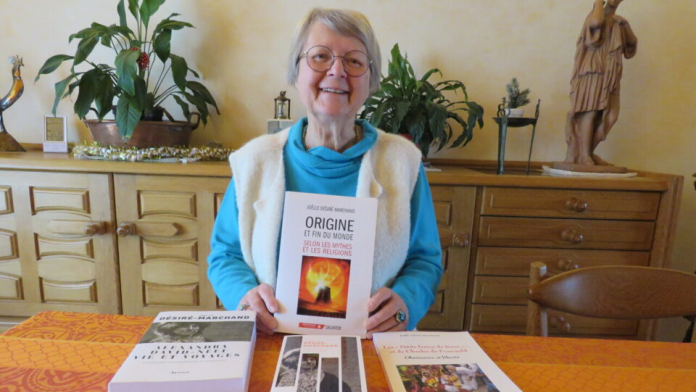
At 8 PM at the Salle des Nouettes on Wednesday, 10 January, Joëlle Désiré-Marchand, a member of the Dialogue for Peace Association in Sables-d’Olonne, revealed everything she knew about Hinduism, one of the most practised religions in the world. “It’s the third religion in the world,” Joëlle said.
And for good reason, 80% of the population of India, the most populous country in the world, is Hindu. There are also practitioners in many other countries. To connect to the local European audience, she named Great Britain besides Nepal which the French people are aware of. Of course, Hindus live as a minority in Pakistan and Bangladesh, landmasses that were part of India until 14 August 1947, and also as non-residential Indians across much of western Europe, west Asia (Middle East), Kenya and Nigeria in Africa, the United States and Canada. They live also as descendants of indentured labourers in Trinidad & Tobago and Fiji.
‘More than a religion,’ says Joëlle
Like the country where it originated, the religion of Hinduism has spread across continents. This is why Joëlle Désiré-Marchand decided to dedicate a conference to it, because as she says, it is more than a religion.
A way of life passed down for more than 3,000 years, whose moral integrity remains today despite developments in the world, she says, adding that this hierarchy comes from castes — the crude British translation of varna — groups of societies assigned mostly by heredity.
But according to the speaker, understanding Hinduism is first of all understanding India and its history. A territory that has evolved through empires and invasions until its independence in 1947. Today, India is the fifth-largest economic power in the world, developing further at a break-neck speed, even faster than China.
But it is also “a country of contrasts” as Joëlle describes it. She speaks on the subject confidently. She says she fell for it while working as a cartographer and geographer. Her research work led her to discover the subcontinent while following in the footsteps of the Franco-Tunisian explorer, whose exploits Joëlle discovered.
Joëlle was able to visit the places that Alexandra David-Néel had been to previously. “I read all his works and remembered all the names. It encouraged me to go see these places while travelling with friends,” she said at the event.
These trips took her to Nepal, Tibet and India. From her research, Joëlle published several books, notably a biography of the explorer, but also on some of her relatives, such as her adopted son Aphur Yongden or her secretary Marie-Madeleine Peyronnet.
Today, the writer is recognised as an expert in religions and civilisations. “I have an interest in religions, populations and civilisations. Everything is respectable; it’s just a question of the organisation of society. But it is very linked to the territories.”
In addition to her conference in January, she hosted another in March in the Alps. This was about her research work following in the footsteps of Alexandra David-Néel.
Translated from French from “Les Sables-d’Olonne : cette géographe se consacre à la ‘troisième religion du monde’” and elaborated by Surajit Dasgupta

