


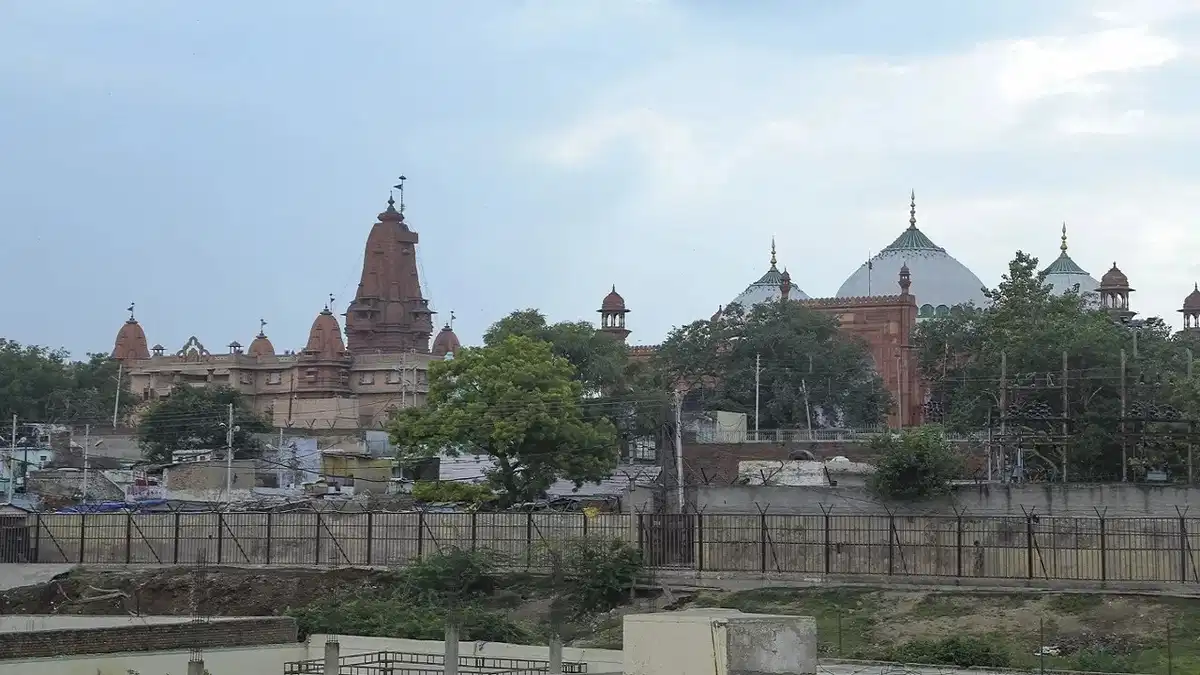
The Supreme Court declined to intervene in a judicial order that consolidated fifteen suits related to Mathura’s SriKrishna Janmabhoomi-Shahi Eidgah Masjid land dispute on Tuesday. Justices Sanjiv Khanna and Dipankar Datta emphasized that having multiple proceedings on the same matter was not suitable and advised the mosque management committee to present their case before the Allahabad High Court first.
Table of Contents
Upon learning that the mosque management committee had filed a plea in the high court to reconsider the 11 January order on the consolidation of suits, the bench dismissed the committee’s petition. They granted the committee the freedom to return to the Supreme Court if they were dissatisfied with the final decision of the high court.
The high court had ordered the consolidation of all 15 suits on 11 January based on a request from the Hindu side under the relevant provisions of the Civil Procedure Code. The Hindu plaintiffs argued that most of the lawsuits contained similar prayers, with some seeking to acquire possession of the Shahi Idgah property and demolish it.
The high court acknowledged the plea and observed that out of the 18 suits filed, 15 of them share a similar nature. Consequently, the court can handle and make decisions on these cases concurrently, relying on the same evidence.
“To save the time of the Court, the expenses to be incurred to the parties, and to avoid conflicting judgments it appears expedient in the interest of justice to consolidate the suits with each other,” the high court said in its order of 11 January.
Several lawsuits related to the land dispute between Sri Krishna Janmabhoomi-Shahi Eidgah Mosque have a shared demand to reclaim the 13.37-acre land where the mosque is located and return it to the Shri Krishna Janmabhoomi Trust. The mosque is adjacent to the temple, and the lawsuits aim to invalidate a compromise reached in 1968 between the mosque committee and Shri Krishna Janmasthan Seva Sangh, which allowed the mosque to remain in its current position.
Muslims play Supreme Court-High Court ping-pong
Since July 2023, the Supreme Court has been examining the challenge to the 26 May order of the Allahabad High Court, which transferred all suits filed by Hindu parties claiming rights over the mosque land to itself. The mosque committee has argued that it lacks the financial resources to defend the suits in the Allahabad High Court, which is 600 km away and would prefer to have the case heard in Delhi, which is only 150 km away.
The 26 May order by the high court was made in response to a plea by Bhagwan Shrikrishna Virajman at Katra Keshav Dev Khewat Mathura (deity), represented by their next friend, Ranjana Agnihotri, who is also an advocate, along with seven others. A next friend is a legal representative appointed for someone unable to maintain a lawsuit directly. The Hindu plaintiffs requested that the original trial be conducted by the high court due to the national importance of the matter.
On 14 December, the Allahabad High Court, in the absence of a stay from the Supreme Court, issued an order for a survey of the mosque. This survey was requested by Hindu plaintiffs who claim that the mosque contains evidence indicating its past as a Hindu temple. This development marks a significant turning point in the long-standing dispute, which is part of a larger collection of cases where Hindu petitioners are seeking legal changes to assert their rights over Islamic holy sites.
However, on January 16, the Supreme Court temporarily halted the survey of the mosque. The court noted that the plea made by the Hindu side for the survey was lacking in specificity and raised important legal issues. The order to halt the survey was extended on January 29. The court is expected to address the matter again in the first week of April, along with a separate set of petitions challenging the high court’s decision to transfer 18 suits from various civil courts in Mathura to itself for hearing.

