


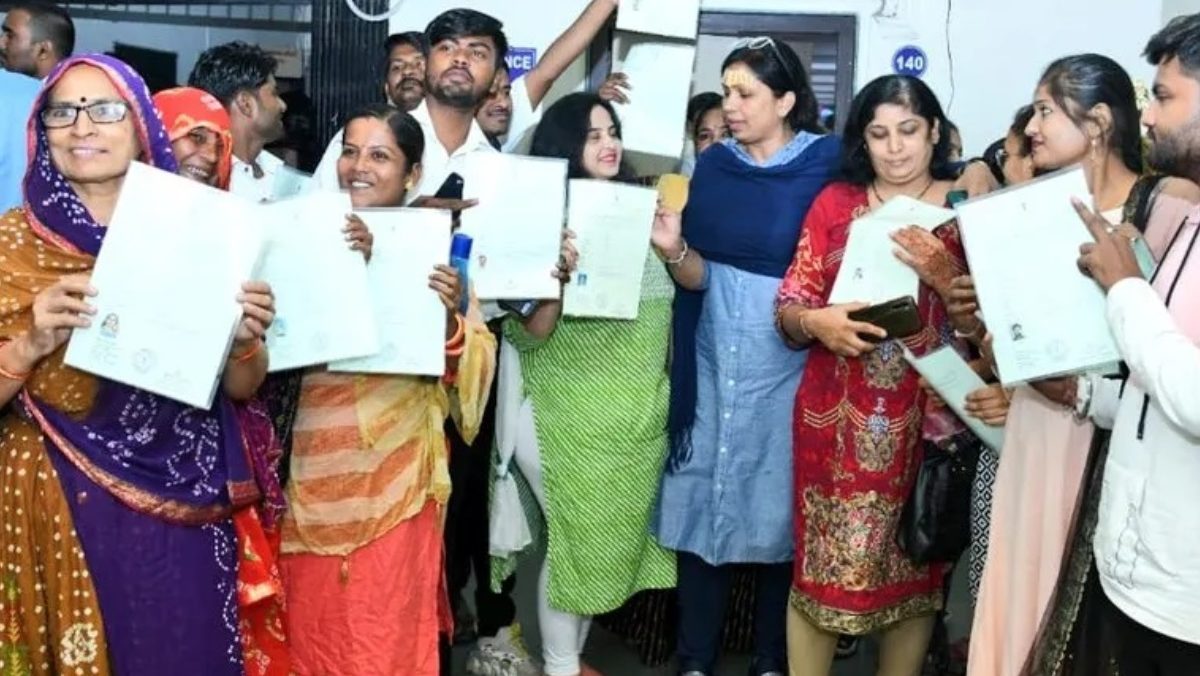
While the Citizenship Amendment Act (CAA) has not yet come into force despite its notification, a camp held at the district collector’s office in Ahmedabad, Gujarat, turned out to be a significant event for 18 Hindus, all refugees from Pakistan who were granted Indian citizenship on 16 March. The ceremony was graced by the presence of Gujarat’s Minister of State for Home Harsh Sanghavi, who delivered an inspiring speech, urging the newly granted citizens to actively contribute to the development of their new homeland.
Table of Contents
The authority to grant Indian citizenship to minorities from Pakistan, Afghanistan, and Bangladesh lies with the district collectors of Ahmedabad, Gandhinagar, and Kutch, as stated in the gazette notifications of 2016 and 2018. This provision has paved the way for the successful integration of these refugees into Indian society.
A total of 1,167 Hindus from Pakistan residing in Ahmedabad have been granted Indian citizenship, according to an official statement.
During the ceremony, Sanghavi expressed his gratitude towards Prime Minister Modi and Union Home Minister Amit Shah for their efforts in facilitating Indian citizenship for minorities from neighbouring countries. Their dedication and commitment to ensuring the welfare of these refugees have been instrumental in making this camp and subsequent grants of citizenship possible.
The implementation of the CAA, 2019, was announced by the union government on 11 March. This act aims to provide citizenship to undocumented non-Muslim migrants from Pakistan, Bangladesh, and Afghanistan. The camp held in Ahmedabad is a testament to the government’s commitment to fulfilling this objective and ensuring that those who have faced persecution in their home countries find a haven in India.
Overall, the camp held at the district collector’s office in Ahmedabad was a momentous occasion for the 18 Hindus from Pakistan who were granted Indian citizenship. It symbolises the inclusive and compassionate approach of the Indian government towards those seeking refuge and a better life in the country. With their newfound citizenship, these individuals can now actively participate in the development of their new homeland and contribute to its progress.
When Hindus, other religious minorities of Pakistan, Bangladesh, Afghanistan can get citizenship under CAA
The Citizenship Amendment Act (CAA) was enacted in December 2019 and received the president’s assent, but its implementation was delayed due to the absence of notified rules. However, the union government announced the notification of these rules last Monday. This move has been hailed by Union Home Minister Amit Shah, who stated that Prime Minister Narendra Modi has fulfilled another commitment and honoured the vision of the Constitution’s framers.
With the issuance of the CAA rules, the Modi government will now proceed with granting Indian nationality to persecuted non-Muslim migrants, including Hindus, Sikhs, Jains, Buddhists, Parsis, and Christians, from Pakistan, Bangladesh, and Afghanistan.
“The central government notified the Citizenship (Amendment) Rules, 2024. These rules will now enable minorities persecuted on religious grounds in Pakistan, Bangladesh and Afghanistan to acquire citizenship in our nation. With this notification PM Modi has delivered on another commitment and realised the promise of the makers of our constitution to the Hindus, Sikhs, Buddhists, Jains, Parsis and Christians living in those countries,” Shah said in a post on X last week.
The 2019 CAA amended the Citizenship Act of 1955, allowing Indian citizenship for religious minorities who are persecuted in the neighbouring Islamic nation-states before December 2014. However, the law could not be notified 5 years ago due to nationwide riots by Muslims misguided by the opposition, communists, some celebrities and the Western press to believe their citizenship would be snatched away.
Migrants who entered India by 31 December 2014, and faced religious persecution in their country of origin are eligible for fast-track Indian citizenship within 6 years under the new law. Furthermore, the amendment has also reduced the residence requirement for naturalisation from 11 years to 5 for these migrants.

