


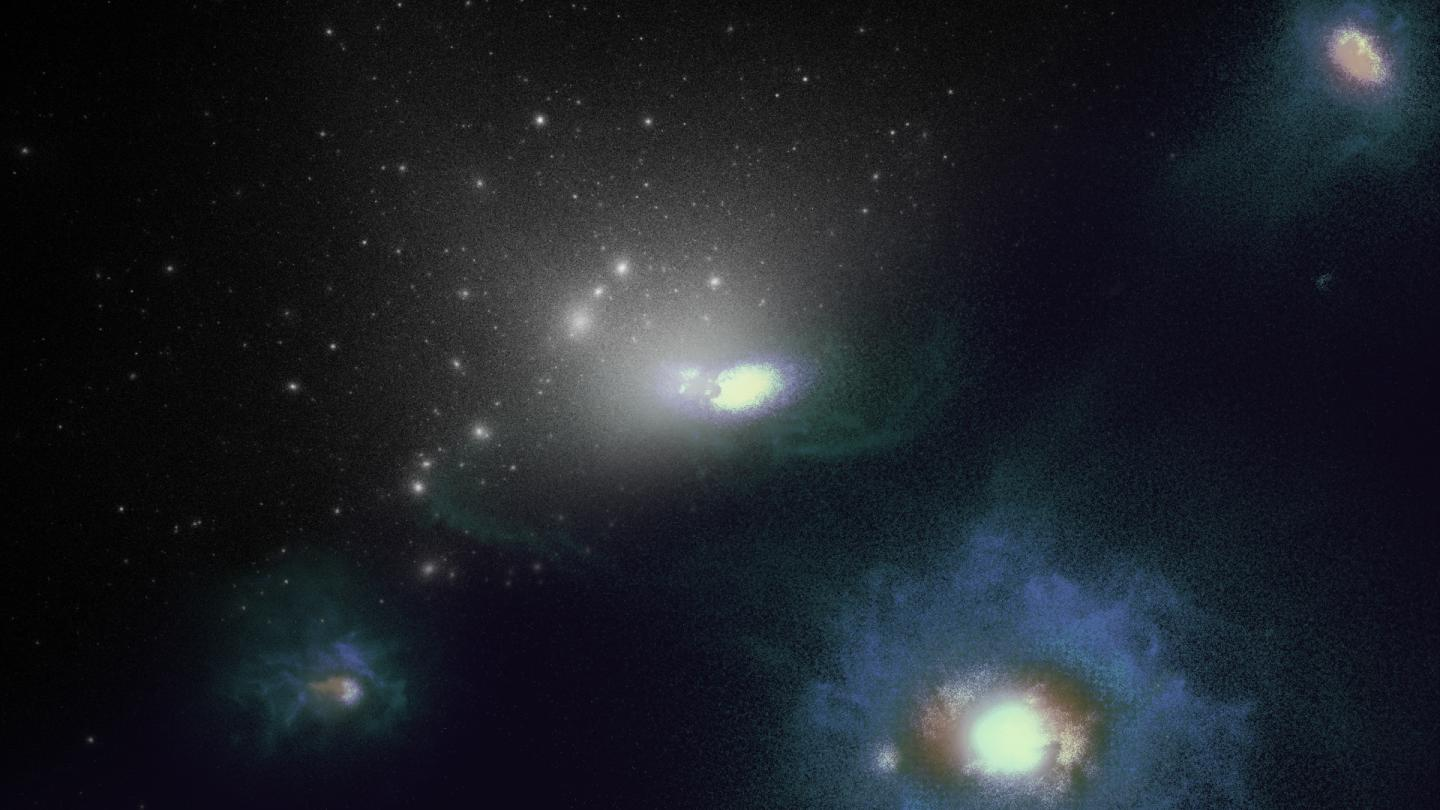
Astronomers have discovered potential early components of the Milky Way, named “Shakti” and “Shiva.” These remnants of galaxies merged with an early version of our galaxy between 12 and 13 billion years ago, contributing to its initial growth. The discovery is akin to archaeologists finding traces of an initial settlement that expanded into a large modern city. This required integrating data for nearly 6 million stars from ESA’s Gaia mission with measurements from the SDSS survey. The findings have been published in the Astrophysical Journal.
Table of Contents
The Milky Way’s early history involves the merging of smaller galaxies, forming large building blocks. Khyati Malhan and Hans-Walter Rix from the Max Planck Institute for Astronomy have identified two of these early building blocks that can still be recognised today: proto-galactic fragments merged with an early Milky Way version between 12 and 13 billion years ago, at the dawn of galaxy formation in the Universe. Named Shakti and Shiva, these components were found by combining data from ESA’s Gaia astrometry satellite with data from the SDSS survey. For astronomers, this is akin to finding traces of an early settlement that grew into a large modern city.
Tracing origins of stars that came from other galaxies
When galaxies collide and merge, multiple processes occur simultaneously. Each galaxy carries its hydrogen gas reservoir, which becomes destabilised upon collision, leading to the formation of numerous new stars. The incoming galaxies also have their own stars, which intermingle during a merger. Over time, these “accreted stars” contribute to the stellar population of the new combined galaxy. Once the merger is complete, identifying which stars originated from which galaxy may seem impossible. However, there are methods to trace stellar ancestry.
Basic physics offers assistance. When galaxies collide and their stellar populations mix, most stars retain fundamental properties directly linked to the speed and direction of their original galaxy. Stars from the same pre-merger galaxy share similar values for both energy and angular momentum — the momentum associated with orbital motion or rotation. For stars moving in a galaxy’s gravitational field, both energy and angular momentum are conserved over time. Identifying large groups of stars with similar, unusual values for energy and angular momentum can point to a merger remnant.
Additional clues aid in identification. More recently formed stars contain more heavier elements, or “metals,” than stars formed long ago. Lower metal content (“metallicity”) indicates an earlier formation. To find stars that existed 13 billion years ago, one should look for “metal-poor” stars.
Virtual excavations in a large data set
Identifying stars that joined the Milky Way from other galaxies has only become possible in recent years. It requires extensive, high-quality data sets and sophisticated analysis techniques to identify the sought-after objects. This type of data has only been available for a few years. The ESA astrometry satellite Gaia offers an ideal data set for such galactic archaeology. Launched in 2013, Gaia has produced increasingly accurate data over the past decade, now including positions, changes in position, and distances for nearly 1.5 billion stars within our galaxy.
Gaia data has revolutionised the study of star dynamics in our galaxy, leading to the discovery of previously unknown substructures. This includes the Gaia Enceladus/Sausage stream, a remnant of the most recent large merger the Milky Way underwent between 8 and 11 billion years ago. It also includes two structures identified in 2022: the Pontus stream found by Malhan and colleagues and the “poor old heart” of the Milky Way identified by Rix and colleagues. The latter is a population of stars formed during the initial mergers that created the proto-Milky Way and continues to reside in our galaxy’s central region.
Traces of Shakti and Shiva
For their current search, Malhan and Rix used Gaia data combined with detailed stellar spectra from the Sloan Digital Sky Survey (DR17), which provides detailed information about the stars’ chemical composition. Malhan says: “We observed that, for a certain range of metal-poor stars, stars were crowded around two specific combinations of energy and angular momentum.”
Unlike the “poor old heart,” which was also visible in those plots, the two groups of stars had comparatively large angular momentum, consistent with groups of stars from separate galaxies that merged with the Milky Way. Malhan has named these two structures Shakti and Shiva, the latter a principal deity of Hinduism and the former a female cosmic force often depicted as Shiva’s consort.
Their energy and angular momentum values, along with their overall low metallicity similar to that of the “poor old heart,” make Shakti and Shiva likely candidates for some of the Milky Way’s earliest ancestors. Rix says: “Shakti and Shiva might be the first two additions to the ‘poor old heart’ of our Milky Way, initiating its growth towards a large galaxy.”
Several ongoing or upcoming surveys promise to provide additional relevant data, including spectra (SDSS-V, 4MOST) and precise distances (LSST/Rubin Observatory), which should help astronomers determine whether Shakti and Shiva are indeed glimpses of our galaxy’s earliest prehistory.

