


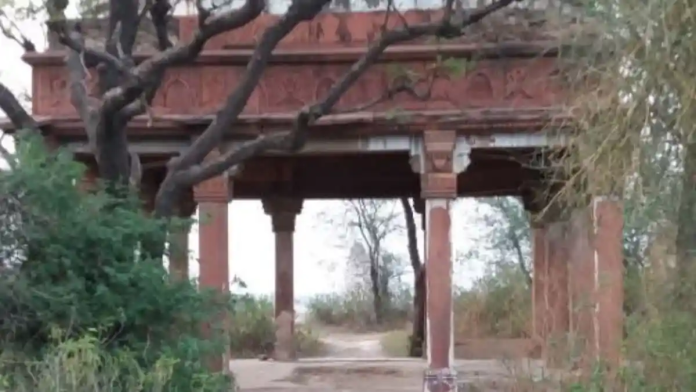
After a long legal battle of 53 years and eight months, Hindus have achieved a big victory in the court over a plot believed to have housed the Lakshagriha (the house of lacquer) mentioned in the Mahabharata where Kauravas had hatched a plot to burn their cousins, the Pandavas, to death. According to law correspondents covering the case, Hindus presented several pieces of solid evidence since the time the suit was filed in 1970 while Muslims could not prove that the Sufi dargah (mausoleum) in the Barnawa village of Uttar Pradesh did not stand on a plot considered historically significant by the older community of Hindus.
In 1960, Krishnadutt Maharaj, the first defendant in the case, established the ashram; the committee was registered five years later. Later, Khan filed an appeal in the court in 1970, claiming that the land was occupied by the Hindus. This case went from a Meerut court to the Baghpat district in due course.
The Muslim party to the dispute could not furnish concrete evidence to the court against the evidence presented. Neither could they explain why a carbon dating of human remains found on the ancient mound was not done. Nor could they provide solid evidence of the existence of graves in every corner of the mound. The Hindus not only presented the report of the commission but also presented the reports of Sardhana Tehsil and the Archaeological Survey of India (ASI) in the court — supported by evidence.
How Hindus won
According to the notification published in the official gazette of the then United Pradesh Government on 25 November and 27 December 1920, as well as per the Ancient Archeology Protection Act, 1904, the mound located 19 miles north-west of Meerut was declared as Lakha Mandap Ancient Archaeology, which later, on the orders of the SDO of Sardhana on 4 March 1965, was registered as Lakha Mandap.
The report of the commission was presented in the court, in which the entire mound was said to be made of a special type of clay that could only be remains of ancient and broken pottery. On these grounds, the ancient mound was called Lakha Mandap, the Hindus argued. The mound was also described as an ancient relic of the Mahabharata period. The report mentioned the wall as well. The commission report was considered special evidence.
The defendant mentioned in the court that there was a yajnashala, a gaushala, a hostel, a Sanskrit college, a statue of Mahatma Gandhi, the gate named after former Prime Minister Lal Bahadur Shastri, a Shiva temple, an ancient well etc. on the disputed land.
The defendant cited records such as statements of Secretary to the Government of Uttar Pradesh Zaheer Ul Hasan on 21 May 1959, Naib Tehsildar Sardhana on 27 December 1965 and Tehsildar Sardhana’s report on 12 February 1965 submitted on 15 February 1965, which wrongly registered the dargah in the court records. The report said that it should be Lakha Mandap.
The court also observed that the Muslim side could not establish whether the disputed site was a Waqf property or a graveyard in 1920, Ranveer Singh Tomar, the lawyer on the side of Hindus, said.
“We submitted all our evidence but it was the court’s decision. We will appeal to a higher court. There was a Mazaar (shrine) and a Kabristan (graveyard); we have all the documents,” said Irshad, who is familiar with this case.
“They people used to claim this as a graveyard but the court has released its verdicts in our favour and said this was Lakshagrah as claimed by the Hindus,” Vijaypal, one of the defendants, said. “We are happy about the verdict, these people wanted to capture our land but we have clear documents and proofs about our claim.”
How Muslims lost
In the report of the commission, the surface of the mound was said to comprise a special kind of earthen pottery, ancient concrete bricks and human bones found in a broken earthen pot, but the plaintiff Mukim Khan neither got the bones carbon dated nor tried to determine the age of the bones through some other scientific method.
The Muslim side said that there was a 600-year-old tomb of Maqdoom Shah Vilayet at the disputed place, registered in the Sunni Central Waqf Board and that was the Mutawwali but did not explain in the statement why the register was protected under Section 30 of the Waqf Board Act, 1960. The Muslims did not present or clarify what objection was raised against the notification issued in 1920.
In his testimony, witness Mazhar Ahmed stated that there were graves in every corner of the disputed land, which does not appear to be correct as per the commissioner’s report and map attached to the file. The witness also stated in his statement that people farmed on 20-25 bighas of the disputed land. A gaushala, a gurukul, an ashram — run by Shree Gandhidham Samiti Lakshagraha — stand on the 108 bigha plot nearby.
“In its 32-page order, the court found problems with the plaintiff’s claims about the land. The Muslim side said the tomb of the Sufi saint was 600 years old and that after his death, a graveyard grew that was given to the Waqf by the ‘Shah’, but they couldn’t say who that ruler was. There is no record of the graveyard in government files,” said Tomar.
“We have indeed lost the case but we will certainly go to a higher court,” said Shahid Ali, the lawyer for the Muslim side.
DM, SP oversee security of ‘Lakshagriha’
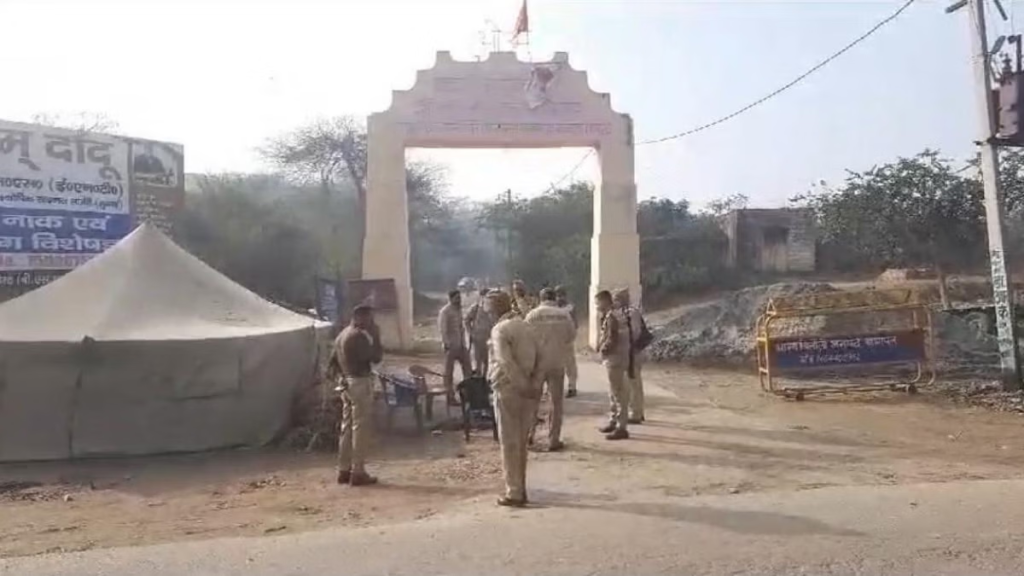
DM Jitendra Pratap Singh and SP Arpit Vijayvargiya reached the ‘Lakshagriha’ in Barnawa village where rivers Hindon and Krishna meet and camped there for a long time, giving directions to the police. After inspecting the plot, both officers sought information from the acharya of the local gurukula. The police conducted a special vigilance of the ancient mound located at Lakshagrih in Barnawa village after the court’s decision in favour of the Hindu side after 53 years.
Police personnel are deployed at the main gate of the plot and at different places on the premises, not allowing the general public to visit the ‘Lakshagriha’. Yesterday, DM Jitendra Pratap Singh and SP Arpit Vijayvargiya reached the plot. Both officers toured the campus and the ASI-protected area, taking stock of the arrangements.
While advising caution to Inspector MP Singh and the deployed policemen, the officers gathered information from Acharya Devendra Shastri of Shri Mahanand Sanskrit Vidyalaya Gurukul about the history of the believed Lakshagriha, its geographical location, officials of Gandhidham Committee running the Sanskrit school, the teaching system the gurukul employs, the number of students and teachers, hostel arrangement etc.
Hindus relied on pre-1970 sermons as evidence
At the entrance of a cave named Lakshagriha Gufa, there is a board that reads: “To the south of the village, there is this mound about 100 ft high and spread over 30 acres of land, which is considered to be the remains of Lakshagriha. There are two tunnels located under this mound in which the Kauravas had unsuccessfully plotted to kill the Pandavas.”
Ompal Singh Shastri, an alumnus of the Sanskrit Department of Chaudhary at the Charan Singh University, Meerut, and Sanskrit College, Barnawa, said that Brahmachari Krishnadutt Maharaj was a resident of Khurrampur Salemabad in District Ghaziabad. He had moved to the Barnawa village, after which he gave sermons lying on the plot. The historicity of this land can be understood only through the sermons of Brahmachari Krishna Dutt Ji Maharaj, he said.
Shastri said that the plot presently housed the Sanskrit College, the gaushala and six yajnashalas at the ‘Lakshagriha’ while about 100 rooms stand on the land, a part of which is cultivated. Every year, two mahayajnas are performed at the ‘Lakshagriha’ while Akhand Samaveda Parayan Yajna is performed on Rakshabandhan. About a week before Holi, Chaturveda Brahma Parayana Mahayagya takes place, which lasts for eight days.
“Now that we have won the case, we can move forward with our plans. We want our students to get Shashtri and Acharya degrees from here, for which we will ask the government for funds,” Shree Gandhidham Samiti Lakshagraha head Rajpal Tyagi said.

