


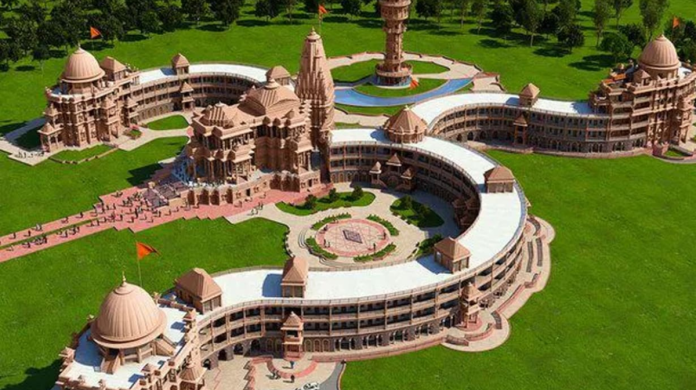
The first Om-shaped temple in the world is going to be inaugurated on 10 February, Swami Phulpuri of the Om Ashram said. Situated in Village Jaddan, District Pali, Rajasthan, the temple is to be known also as the Om Shiv Mandir.
Swami Maheshwaranand Maharaj, who commands a following from all over the world, said this Om-shaped temple would be the first of its kind. The temple has been built on a plot of 270 ac. Its foundation was laid in the year 1995. It is now in the final stage of construction, with 400 labourers working on it.
In its upper part, the temple is made of a special crystal brought from the Bansi hills of Dholpur. A tank with a capacity of 2 lakh tonnes has been built beneath this temple complex.
The temple will be home to 1008 murtis of Shiva, including replicas of 12 Jyotirlingas. Above Shiva will be a depiction of the universe.
The Shiva temple is divided into four sections. One entire section is built underground while three sections are above ground.
The temple is 135 feet long and supported by 1,200 pillars. It has 108 rooms and the samadhi of Guru Madhavananda at the centre of the premises.
After Ayodhya, this is another temple built in the Nagara style of architecture. The temple will showcase the rich Hindu culture and architectural heritage.
Theology behind temple
Om is a symbol representing a sacred sound, syllable, mantra, and invocation in Hinduism. Its written representation is one of the most important symbols of Hinduism. It is variously said to be the essence of the supreme Absolute, consciousness, ātman, Brahman, or the cosmic world.
In Indic traditions, Om serves as a sonic representation of the divine, a standard of Vedic authority and a central aspect of soteriological doctrines and practices. The syllable is often found at the beginning and the end of chapters in the Vedas, Upanishads and other Hindu texts.
Om emerged in the Vedic corpus and is said to be an encapsulated form of Samavedic chants or songs. It is a sacred spiritual incantation made before and during the recitation of spiritual texts, during puja and private prayers, in ceremonies of rites of passage (samskara) such as weddings, and during meditative and spiritual activities such as Pranava yoga.
Om is part of the iconography found in ancient and mediaeval-era manuscripts, temples, monasteries, and spiritual retreats in Hinduism, Buddhism, Jainism, and Sikhism. As a syllable, it is often chanted either independently or before a spiritual recitation and during meditation in Hinduism, Buddhism, and Jainism.
The syllable Om is also referred to as Onkara (or Omkara) and Pranava among many other names.
Om + Shiva
Om Namah Shivāya (ॐ नमः शिवाय) is one of the most popular Hindu mantras and the most important mantra in Shaivism. Initially used without ‘Om’, the mantra “Namah Shivāya” means “salutations to the auspicious one”. It is called Shiva Panchakshara or simply Panchakshara, implying the five-syllable mantra (excluding ‘Om’) dedicated to Shiva. This mantra appears as ‘Na’ ‘Ma’ ‘Śi’ ‘Vā’ and ‘Ya’ in the Shri Rudram Chamakam, a part of the Krishna Yajurveda and also the Rudrashtadhyayi, a part of the Shukla Yajurveda, in the 5th chapter (also known as Namakam) verse 41.
Origin of the mantra
The mantra without ‘Om’ was originally a verse in the eighth hymn of the Namakam section of the Shri Rudram (TS 4.5.8.1), taken from the Taittirīya Samhita, a recension of the Black Yajurveda. It appears as, Namaḥ śivāya ca śivatarāya ca (नमः शिवाय च शिवतराय च), which may be translated as “salutation to the auspicious one and to the more auspicious”
How to reach the temple
Jadan Ashram is on National Highway 62 passing through Pali. The airport nearest to it is Jodhpur, about 71 km away. Jadan Ashram can be reached also by train. One needs to travel to the Marwar junction by the express train that plies between Delhi and Ahmedabad. Marwar is 23 km from the national capital. The ashram can also be reached by bus running on the Pali-Sojat route.

