


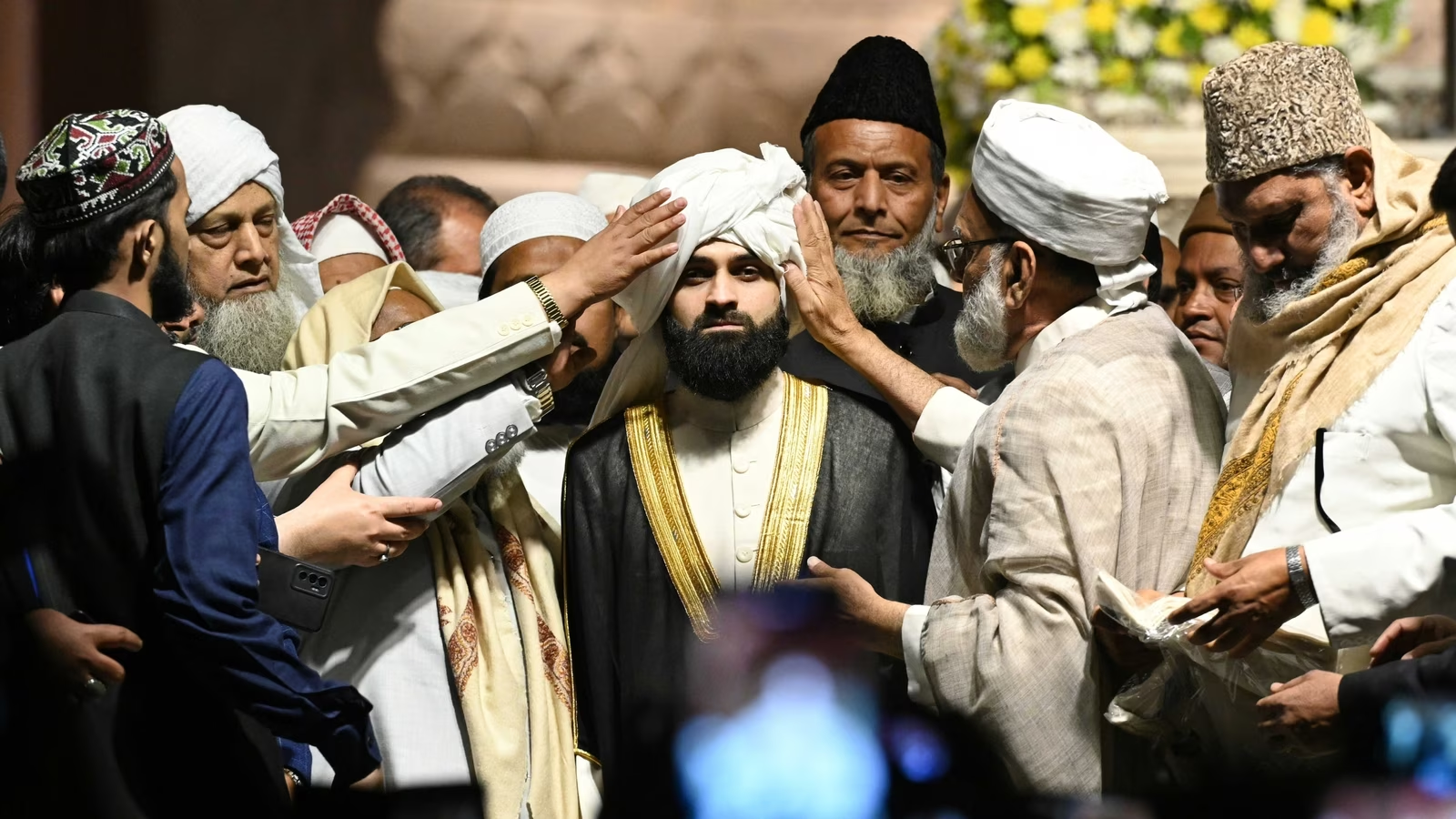
Syed Usama Shaban Bukhari has assumed the role of the new shahi imam of the Jama Masjid, Delhi. In the event called ‘Dastarbandi’, the outgoing Shahi Imam, Syed Ahmed Bukhari, officially declared his son, Syed Shaban Bukhari, as his successor, the 14th in the dynasty of Islamic priests of the grand mosque established by Mughals.
Table of Contents
Appointment of new shahi imam
The Dastarbandi ceremony for Shaban Bukhari took place on the auspicious occasion of Shab-e-Baraat, also known as the ‘Night of Forgiveness’. This holds great significance for Muslims and falls on the 14th and 15th night of Shaban, the eighth month of the Islamic calendar. Following the prayer during the ceremony, the ‘Dastarbandi’ was placed on the head of the succeeding Imam. The term ‘Dastarbandi’ refers to the act of placing a turban on one’s head.
Serving hitherto as the Naib Imam since 2014, Shaban Bukhari has now taken over his father’s position as the new Imam. Currently, he is 29 years old.
After the announcement of making Syed Shaban Bukhari the Imam, the Dastarbandi (coronation) program took place from 9 pm on Tuesday. At the event, Dastarbandi was held in the presence of dignitaries from the national capital including Imams, Ulamas and Maulvis from other states including Delhi.
Invitations had been sent to the embassies of all Muslim countries situated in Delhi for the succession event. The new Imam of Jama Masjid also organised a banquet for all the guests at his residence.
Hierarchical priesthood since era of Mughal Emperor Shah Jahan
Born in Delhi, India, on March 11, 1995, Syed Shaban Bukhari hails from a family of Islamic theologians who have since their past thirteen generations presided over the Jama Masjid, Delhi, India, built in the year 1656 by Mughal Emperor Shahjahan, remembered for the mausoleum Taj Mahal. It was the same emperor who appointed Syed Abdul Ghafoor Shah Bukhari, the great-grandfather of Syed Shaban Bukhari, as the First Imam of Jama Masjid Delhi and decreed that the Imamat shall continue in the same family.
Keeping the tradition, in the year 2014, Syed Shaban Bukhari was appointed as the Vice (Naib) Shahi Imam of Jama Masjid, Delhi, India, by his father, the Thirteenth Shahi Imam, Maulana Syed Ahmed Bukhari.
The new shahi imam’s father Syed Ahmed Bukhari is the son of the 12th Shahi Imam Syed Abdullah Bukhari who died in 2009 at the age of 87. Syed Ahmed Bukhari succeeded his father as Shahi Imam in October 2000. After 23 years and 4 months, the dynastic baton has been passed on once again.
Shaban, who holds a master’s degree in social work from Amity University, was made Naib Imam in 2014. He is a scholar and fazil in Islamic theology. Most of his education about Islam was from Madrasa Jamia Arabia Shamsul Uloom, Delhi. His great-grandfather Syed Abdul Ghafoor Shah Bukhari was appointed the first Imam of Jama Masjid by Emperor Shah Jahan.
He lives with his father, wife Shazia and two sons. Syed Shaban Bukhari has four siblings, two brothers and two sisters.
Love jihad
The wife of the new shahi imam is Shazia who used to be a Hindu before her marriage to Syed Shaban Bukhari on 13 November 2015 at a farmhouse in Delhi’s Mahipalpur. A young Bukhari reportedly fell in love with his Hindu Punjabi classmate, who hailed from Ghaziabad, while they were in college. Initially, they used to meet like normal classmates, but they drew closer and eventually decided to marry.
The Hindu family resented expectedly, but the marriage happened anyway. after which the new Imam Sahib’s wife was named Shazia. Despite repeated requests from journalists, the Bukhari family did not disclose the original Hindu name of the bride nor did they reveal the identity of the Hindu Punjabi family from Ghaziabad.
While the term “love jihad” refers these days to marriage between a Hindu woman and a Muslim man masquerading as a Hindu, which is ill-fated, when it was coined by Christians of Kerala in the period 2005-10, it implied a deliberate ploy by Muslims to engineer a change in the demography of the state by waylaying Christian girls to marry them and produce Muslim children using more wombs than were already available in the Islamic community.

