



News: RSS chief Mohan Bhagwat, speaking on LGBTQ+ rights recently, said that Indian civilisation had traditionally acknowledged the community. In an interview to RSS-affiliated magazines Organiser and Panchjanya, the sarsanghchalak gave the example of Hansa and Dimbhaka (alternatively spelt as “Hamsa” and “Dimbaka”) — two generals of king Jarāsandha, who had waged a long war against Krishna — saying they were “in that sort of a relationship”.
The RSS chief further alleged that Krishna had deceived the two characters into believing that the other had died. When Hansa was told Dimbhaka had died in a battle, the former committed suicide, overpowered by grief. Similarly, Dimbhaka, on knowing that Hama had died, ended his own life. This, according to Bhagwat, proved they were gay (homosexual) lovers!
“LGBT/transgender issues are not new issues; they have always been there… These people also have a right to live. Without much hoopla, we have found a way, with a humane approach to provide them social acceptance, bearing in mind that they are also human beings with an inalienable right to live,” the RSS chief said in the interview.
Bhagwat explained that the LGBTQ community was not new to India and had been part of Hindu society and tradition. He referred to the story from Hindu mythology about the two generals, Hansa and Dimbhaka, who were in the army of Jarāsandha, a powerful king of Magadha.
“Jarāsandha had two generals, Hansa and Dimbhaka. When Krishna fanned a rumour that Dimbhaka had died, Hans committed suicide. What does this story suggest? That the two generals were in that sort of a relationship,” Bhagwat said, hinting that they were gay.
Does the original story in the Hindu epic back Bhagwat’s assertion? It appears in Harivamsa, considered by many scholars to be a part of the Mahabharata.
Hansa, Dimbhaka according to Mahabharata, other traditions
In the Mahabharata, Vaishampāyana, the traditional narrator of the epic, mentions Hansa and Dimbhaka once during the phase when Jarāsandha is supposed to pick one of Krishna, Bhima and Arjuna — all three were in disguise initially but later they revealed their true identities — for a wrestling bout.
The Ashvalayana Grihya Sutra mentions Vaishampāyana as Mahabharatacharya. He is mentioned also in the Taittiriya Aranayaka and the Ashtadhyayi of Pāṇini.
Vyasa taught the Mahabharata of 1,00,000 verses to Vaishampāyana who then recited the epic to King Janamejaya at his sarpa satra (snake sacrifice). The Harivamsha Purana is recited by him too, where he narrates the legend of Prithu’s emergence from Vena.
When Krishna, Bhim and Arjuna meet Jarāsandha, Vaishampāyana narrates the goings-on, saying the duo are named differently in Magadha, Jarāsandha’s kingdom.
Vaishampāyana said:
“… being willing to fight with those heroes of fearful deeds (Krishna, Bhima and Arjuna), Jarāsandha ordered his son Sahadeva to be installed on the throne.
“O best of the Bharata race, when the day for the combat came, the king thought of his commanders-in-chief, Kaushika and Chitrasena.
“O king, they were formerly called by the ever renowned names of Hansa and Dimbhaka by everybody in the world.”
The other places where Hansa and Dimbhaka are mentioned are as follows:
Mahabharata I.60.56, I.61.77, II.13.11 and II.13.36.
Adi Parva, Mahabharata/Book I Chapter 60 gives genealogy of all the principal creatures. Hansa is mentioned in Mahabharata (I.60.56) here:
… And Kaki brought forth the crows; Syeni, the hawks, the cocks and vultures, Dhritarashtri, all ducks and swans; and she also brought forth all Chakravakas; and the fair Suki, of amiable qualities, and possessing all auspicious signs brought forth all the parrots.
In Adi Parva, Mahabharata/Book I Chapter 61 gives genealogy of the Danavas, Asuras, Kauravas, Pandavas, Gandharvas, Apsaras, Rakshasas, Hansa is mentioned in I.61.77 as:
That son of Arishta who was known by the name of Hansa, was born in the Kuru race and became the monarch of the Gandharvas.
The Sabha Parva, Mahabharata/Book II Chapter 13 describes the Kshatriyas who fought for Jarāsandha. Hansa is mentioned in the epic’s II.13.11 part:
There are two others, Hansa and Dimbhaka, of great energy and great soul, who have sought the shelter of the mighty Jarāsandha.
The Sabha Parva, Mahabharata/Book II Chapter 13 mentions Hansa again in verse 36):
… But after the immediate cause of fear was removed (by the death of Kansa), Jarāsandha, his father-in-law, took up arms. Ourselves consisting of the eighteen younger branches of the Yadavas arrived at the conclusion that even if we struck our enemies continually with excellent weapons capable of taking the lives of the foes, we should still be unable to do anything unto him even in three hundred years. He hath two friends that are like unto the immortals and in point of strength, the foremost of all men endued with might. They are called Hansa and Dimbhaka, both incapable of being slain by weapons. The mighty Jarāsandha, being united with them, becomes incapable, I think, of being vanquished by even the three worlds.
There is no mention — or even allusion to the theory — anywhere above that Hansa and Dimbhaka were homosexual partners.
However, there are other stories about Hansa and Dimbhaka. While Shiva Puranas mention them as brothers who carried aspects of Shiva (Shivansha), the community of transvestites, which has appropriated several stories from Hindu epics with ex-post facto justification, mention them as gay partners in their own self-styled discourse. It is likely Bhagwat got the story from there.
A made-up story
For example, Kinnars or Hijdas worship Bahuchara Mata, a goddess with two unrelated stories both associated with transgender behaviour. One of the stories says she appeared in the avatar of a princess who castrated her husband because he would run into the woods and act like a woman rather than have sex with her.
Another story says a man tried to rape her, so she cursed him with impotence. When the man begged her forgiveness to have the curse removed, she relented only after he agreed to run in the woods and act like a woman.
The primary temple to this goddess is located in Gujarat and it is a place of pilgrimage for Hijras, who see Bahuchara Mata as a patroness.
An appropriation
One of the forms of Shiva is a merging with Parvati where together they are Ardhanarishwara, a god that is half Shiva and half Parvati. Ardhanari has special significance as a patron of Hijras, who identify with the gender ambiguity
The legend includes a story where Rishi Bhrigu pleased Shiva and denied to please Parvati. Then Lord Shiva and Parvati merged with each other and showed their form of Ardhanari or Ardhanarishwara, meaning half man and half woman. The form represents that a person has both elements of masculine and feminine. This is, however, an inconclusive argument to suggest the form was an appreciation of transvestites.
Yet another act of co-opting
In a version of the Ramayana, when Rama leaves Ayodhya for his 14-year exile, his subjects follow him into the forest because of their devotion to him. Soon Rama notices this and gathers them to urge them not to mourn and say that all the “men and women” of his kingdom should return to their places in Ayodhya. Rama then leaves for 14 years.
When he returns to Ayodhya, he finds that the Hijras, being neither men nor women, have not moved from the place where he gave his speech. Impressed with their devotion, Rama grants Hijras the boon to confer blessings on people during auspicious inaugural occasions like childbirth and weddings. Specifically, Hijras will perform and bestow their blessings when a son is born. This boon is the origin of “badhai” in which Hijras sing, dance, and give blessings. There is no such story in Valmiki Ramayana.
Misappropriating the Mahabharata
The Mahabharata includes an episode where Arjuna is sent into exile. There he assumes an identity of a transvestite, Brihannala, and performs rituals during weddings and childbirths that are now performed by Hijras.
In another episode, before the Kurukshetra War, Aravan offers his lifeblood to goddess Kali to ensure victory for the Pandavas and Kali agrees. On the night before the battle, Aravan expresses a desire to get married before he dies. No woman was willing to marry a man doomed to die in a few hours, so Lord Krishna (as Mohini) marries him. In southern India, Hijras claim Aravan as their progenitor and call themselves aravanis. This story does not appear in Veda Vyasa’s Mahabharata either.
Every year in Tamil Nadu in April and May, Hijras celebrate an 18-day religious festival at a temple in Village Koovagam in the Ulundurpet taluk in Villupuram district. The temple is devoted to the deity Koothandavar, who is identified with Aravan. During the festival, the Hijras reenact the wedding of Lord Krishna and Lord Aravan, followed by Aravan’s subsequent sacrifice. They then mourn Aravan’s death through ritualistic dances and by breaking their bangles. An annual beauty pageant is also held, as well as various health and HIV/AIDS-focused seminars. Hijras from all over the country travel to this festival. BBC Three documentary India’s Ladyboys as well as the National Geographic Channel television series Taboo depict the personal experiences of Hijras attending this festival.
In the Mahabharata, the story of Hansa and Dimbhaka is like a precedent of what happened in the case of the slaying of Dronacharya, which is a story recalled more often where eldest Pandava Yudhishthira — known for his resolve never to lie — tells the trainer of Pandavas and Kauravas that Ashwatthama is dead. Ashwatthama happens to be the name of Drona’s son as well as that of an elephant whom Bhima had killed. Yudhishthira maintains his resolve with a soliloquy that it was actually the elephant that had died, the sound of which is drowned in the din of the shankha (conch shell) of Krishna. Believing it was his son who had died, Drona puts his weapons on the ground and starts grieving when Drishtadyumna, King Drupada’s son, kills him.
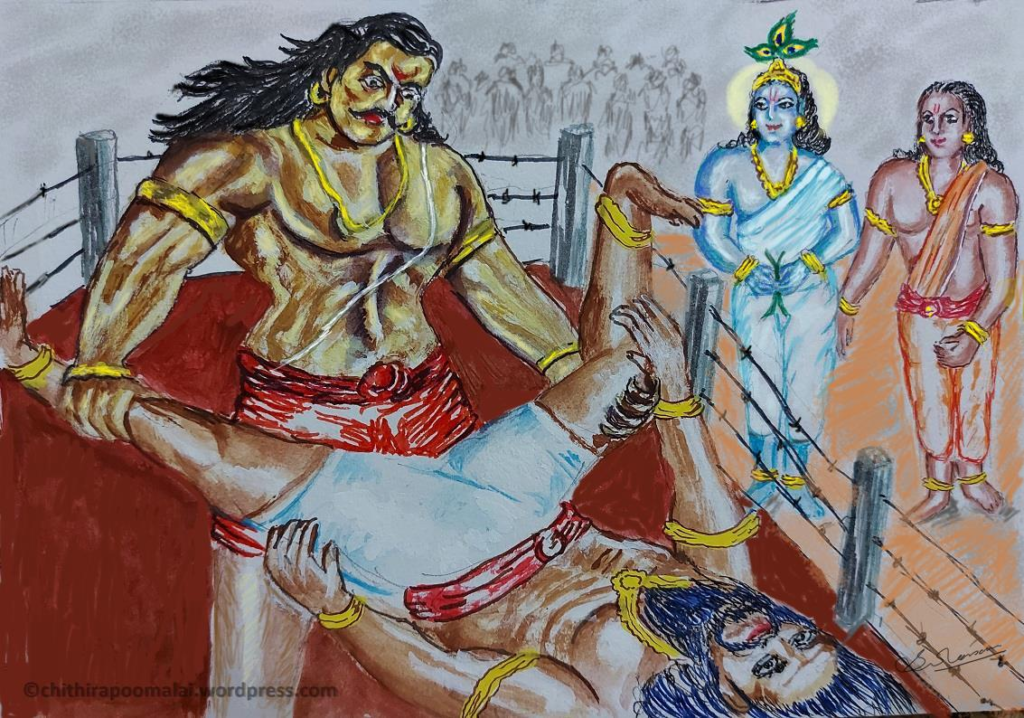
In the episode involving Jarāsandha, Krishna tells Dimbhaka that Hansa, who was actually another king who had been killed by Balarama, had died. Believing that to be his Hansa, Dimbhaka plunges into the Yamuna and drowns. The news reaches Hansa who then commits suicide.
Here again, Hansa and Dimbhaka are mentioned as friendly with each other in one narration and as lovers in the version by the Kinnar community.
Transvestites exist worldwide, but Hijras are unique to the subcontinent
Hijra is a community exclusive to the subcontinent. Transvestites outside India, Pakistan, Bangladesh, Nepal, Sri Lanka and Bhutan do not have a community per se of people of this sexual orientation — castrated male human beings who claim to have been “born this way”, which is not a scientifically established fact.
To make themselves acceptable even in Islamic societies, Hijras identifying as Muslim also incorporate aspects of Islam. Even in Hyderabad, India, a group of Muslim converts were circumcised, something seen as the quintessential marker of male Muslim identity.
Since Deoband forbids reaching Allah through a Sufi, Hijras in Islamic countries of the subcontinent, Pakistan and Bangladesh, bank on the Barelvi belief of an intermediary between God and man. There are transvestite pirs exclusive to the Hijra community under the Barelvi sect of Muslims of Pakistan and Bangladesh.
The 1992 film Immaculate Conception by Jamil Dehlavi is based upon the culture clash between a western Jewish couple seeking fertility at a Karachi shrine known to be blessed by a Sufi fakir called ‘Gulab Shah’ and the group of Pakistani eunuchs who guard it.
Murad (in English, Eunuch’s Motherhood), was an award-winning biographical telefilm drama made by Evergreen Media Europe for Pakistan’s television channel Indus TV that aired in 2003. It featured some of the country’s top male television actors — Sohail Asghar, Nabeel, Qazi Wajid, and Kamran Jilani playing the roles of Hijras. It was directed by Kamran Qureshi, written by Zafar Mairaj and produced by Iram Qureshi. It won both Best TeleFilm and Best Director awards at the 2003 Indus Telefilm Festival. The story revolves around Saima, a transgender woman, who adopts a child named Murad. For the first time, influential male actors showed their support for hijra rights during interviews, pointing out that in Pakistani English at that time eunuch was the term to describe a transgender person, and Khwaja Sara had not yet replaced what is now considered a derogatory term due to decades of heckling and name calling.
In 2004, Kamran Qureshi directed Moorat (in English, Eunuch’s Wedding). It a 33-episode series produced by Humayun Saeed and Abdullah Kadwani with more than a dozen cast members. It was nominated for Best Drama Serial, Abid Ali for Best Actor, and Maria Wasti for Best Actress at the Lux Style Awards 2005.
The show was credited with making people understand the pain and abuse that hijra constantly endures when people make fun of the way they look or dress. The story involves a young lady who is engaged to be married. It turns out her husband is transgender. The story unfolds the trans community and their deprived and isolated world. It portrays eloquently how they, too, are not far away from human emotions and feelings and their world is not much different from the heterosexual community. Even though they are in plain sight, they are taboo subjects and are not taken seriously. This makes them suffer endlessly in silence wrapped in slurs. The 33-episode series, therefore, touches on transgender abuse, abuse against women, poverty, the immorality of arranged marriages and child abuse.
Bol is a 2011 Urdu-language Pakistani social drama film. It concerns a patriarch, Hakim, who is a misogynist, a domestic abuser, a bigot and a zealot who forces religion on his family. They face financial difficulties due to Hakim wanting a son. He rejects his transgender daughter, Saifi, as he wanted an heir and she identifies as a girl. Saifi is deeply loved by the rest of her family. As she grows up, men want to take advantage of her and she does not understand at first. However, her oldest sister intervenes and teaches Saifi about what kind of touching is inappropriate. As Saifi grows older, she is not allowed to leave the house. She finds her sister’s dresses compelling and tries them on, revealing her gender identity. A neighbour played by famous South Asian singer Atif Aslam, who is in love with one of the sisters, gets Saifi a job at a place where they paint trucks, with the blessing of Saifi’s sisters and mother. Saifi dresses like a boy; however, other boys sense her lack of self-esteem and eventually gang-rape her. She is saved when another transgender person, played by Almas Bobby (a transgender actor), finds her and takes her home. Hakim overhears Saifi telling her mother and Zainab what happened. When everybody is asleep, Hakim locks the room and suffocates his child for luring the men for the “shame” he would have to bear if the story got out. It received several positive reviews from critics and went on to win the Best Hindi film award in the IRDS Film awards 2011 by Institute for Research and Documentation in Social Sciences (IRDS).


It is not clear on whether the author of this article actually criticises Mr Bhagwat or support him. It is very much clear from the scriptures of Sanatan Dharma that Mr Bhagwat has maligned the historical characters of Sanatan Dharma just to look good in the present situation… Author should have given a clear opinion that. Niw that FIR has been registered against Mr Bhagwat on this particular issue, it’ll be wise nit to confuse the case with unnecessary details. Harivansh Puran gives the clear picture on this issue.
It is critical. The article says Mohan Bhagwat is ill-informed or politically motivated.