


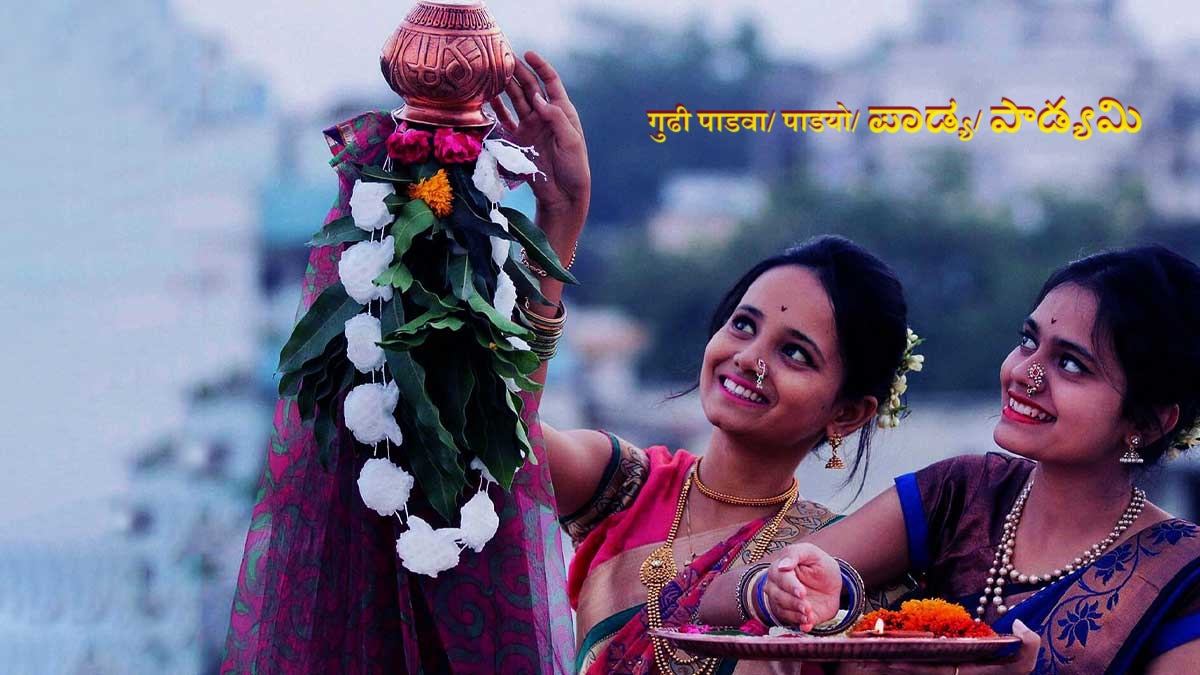
Gudi Padwa, a Hindu festival primarily celebrated in Maharashtra and Goa, carries significant religious importance for the Marathi and Konkani Hindu communities. This festival falls on the first day of Chaitra, signifying the commencement of the Hindu New Year in many regions of India. The year 2024 will witness the celebration of Gudi Padwa on 9 April.
Table of Contents
The commencement of the lunisolar new year for Hindus, particularly those of Marathi and Konkani descent, is signified by the festival. It is observed in Maharashtra, Goa and Daman.
Gudi Padwa as a mark on the calendar
Gudi Padwa marks the onset of spring and the harvesting of rabi crops.
In rural Maharashtra, this festival is connected to Shiva’s dance and the unity of the community as they collectively transport the Gudi Kavads to a Shiva temple.
Sindhis commemorate the day as Cheti Chand, marking the advent of the day of Jhulelal (Krishna). Prayers are dedicated to Jhulelal and the festival is celebrated by preparing delicacies like tahiri (sweet rice) and sai bhaji.
How people hoist the ‘gudi’
Gudi is synonymous with ‘flag’. Its roots can be traced back to Dravidian (peninsular Indian) origins. The term pāḍavā, on the other hand, is linked to the Sanskrit word pratipada, which signifies the first day of each fortnight in a lunar month. This day marks the appearance of the moon after the new moon day (amāvāsya) or the day following the full moon. During this celebration, a gudi/gudhi is raised, hence the festival’s name. Additionally, the term padva/padavo is also connected with Balipratipada.

The festivities are distinguished by vibrant floor decorations known as rangoli, a unique gudi dvaja; which consists of a saree or dhoti or another piece of cloth adorned with flowers, mango, and neem leaves; a sugar crystal garland called gathi, topped with inverted silver or copper vessels. The revelry involves street gatherings, dancing, and relishing festive delicacies.
During the celebration of Gudi Padwa, households adorn gudis or gudhis. These gudis are vibrant and colourful silk scarf-like cloths that are tied at the top of a long bamboo. Neem and mango leaves, along with a garland of flowers, are attached to the gudi. To signify victory or achievement, a silver, bronze, or copper pot (handi or kalash) is placed on top of it.
In some regions, there are temples situated on hilltops. Groups of people collaborate to help transport the kavad to the summit.
Customarily, families typically make a unique dish that combines different flavours, specifically the bitter neem tree leaves and sweet jaggery (gur, gul). Other components consist of sour tamarind and astringent dhane seeds. Similar to the pacchadi recipe utilized during the Ugadi festival, this dish is consumed to symbolize life’s blend of pleasant and unpleasant encounters, along with the belief that the neem-infused mixture possesses health advantages.
Why people raise the gudi
This celebration is associated with the legendary day when Brahma brought time and the universe into existence. For certain Hindu sects, it symbolises the crowning of Rama in Ayodhya following his triumph over Ravana, or the initiation of the Shalivahan calendar after his conquest of the Huns in the ancient era.
While Gudi Padwa marks the new year in the aforementioned states, it also commemorates the triumph of Maratha warriors through processions.

Raising a gudi holds several significances, including:
- It symbolises the victory of King Shalivahana, as his people hoisted the gudi upon his return to Paithan.
- It represents Brahma’s flag mentioned in the Brahma Purana and may also symbolize Indra’s flag.
- It is believed to ward off evil and invite prosperity and good luck into the household.
Regional appellations
In Maharashtra, the initial day of the bright phase of the moon is termed gudi padva. The name of the event is written as गुढी पाडवा in Marathi, पाडयो in Konkani, ಪಾಡ್ಯ in Kannada and పాడ్యమి in Telugu.
Konkani Hindus refer to the day in various ways such as सौसार पाडवो and सौसार पाडयो.
Telugu Hindus observe the same occasion as Ugadi, while Kannada speakers call it ಯುಗಾದಿ.
The festival is recognised by various names across different regions and communities. Among the Assamese of Assam, it is referred to as Bihu. The Kashmiri Pandits in Jammu and Kashmir know it as Navreh. The Bengalis in West Bengal and Bangladesh celebrate it as Poyla Baishakh. In Tamil Nadu, the festival is known as Puthandu among the Tamils. The Punjabis in Punjab celebrate it as Vaisakhi or Baisakhi. Lastly, among the Malayalis in Kerala, it is known as Vishu.
Gudi Padwa 2024
The pratipada tithi for Gudi Padwa 2024 starts at 11:50 PM on 9 April this year and ends at 08:30 PM the next day.
The Marathi Shaka Samvata 1946 commences on this Gudi Padwa.
Gudi Padwa 2024: FAQs
When will Gudi Padwa be observed in 2024?
Gudi Padwa will be celebrated on the pratipada tithi of Shukla Paksha in Chaitra, specifically on 9 April 2024.
How do people celebrate Gudi Padwa?
Gudi Padwa is celebrated by raising the Gudi outside homes, making traditional dishes like Puran Poli, and exchanging greetings and gifts with loved ones. Additionally, individuals visit temples and offer prayers.
Not the New Year for all Hindus
This is not the universal new year for all Hindus. For some, like those in and around Gujarat, the New Year festivities align with the five-day Diwali festival. In Bengal and certain regions of Odisha and the Northeast, the new year falls on Vaisakh between 13 and 15 April, following the solar cycle aspect of the Hindu lunisolar calendar. This is widely embraced not only by Hindus of the Indian subcontinent but also by Buddhists and Hindus of south-east Asia.