


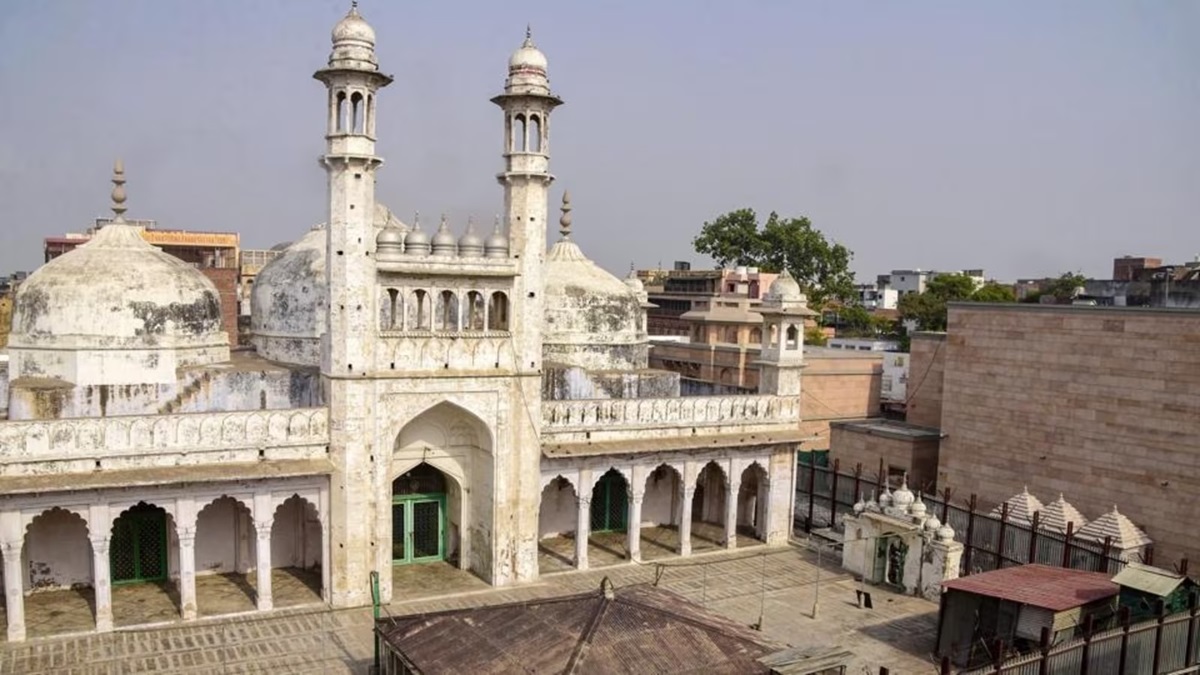
The Supreme Court on 16 January asked the petitioners — a group of Hindu women — in the Kashi Vishwanath Temple-versus-Gyanvapi Mosque case to move a different, proper application to ask for an archaeological survey of that section in the mosque where the Hindu side insists a Linga has been found, which Muslims claim to be a fountain for wuzoo (ablution before namaz).
The Chief Justice of India Dhananjaya Y Chandrachud-led bench asked senior counsel Madhavi Divan to file a formal application after the latter requested a survey of the area of the Gyanvapi structure that has remained sealed under the order of the apex court. The bench, also comprising Justices JB Pardiwala and Manj Misra, told Divan, the advocate of the Hindu women plaintiffs, “You file a proper application and then we will see”.
An order of survey would imply modifying the May 2022 order of the apex court. Under the order of the Supreme Court in July, the Varanasi district court had ordered an extensive survey of the Gyanvapi mosque by the Archaeological Survey of India (ASI) to find out if the mosque was built over a pre-existing Hindu temple. Whereas until the litigations, historians consensually said Kashi Vishwanath Mandir was vandalised and partially demolished under an order from Mughal Emperor Aurangzeb, the petitioners argued that the scientific investigation was “necessary” for the “true facts” (sic) to come out.
The court order excluded the sealed area.
Ping-pong between Supreme Court, lower courts
The high court upheld the order above, but in September, the apex court refused to halt the ASI survey of the mosque, saying that the agency would carry out its survey only using “non-invasive” (that do not involve demolition tools) methods. The ASI survey has since been completed.
Today, Divan told the bench that her clients wanted a survey of the area that has remained sealed following the order of the apex court in May 2022. She argued, “The area that is sealed is of utmost sacredness to us because our case is that it has a Shivling. A survey was ordered by the trial court but the area under seal has been excluded.” The Hindu side will request a survey of the sealed area, she said.
Senior lawyer Huzefa Ahmadi, who is representing the Gyanvapi mosque management committee, said that they would respond to the application after it was filed.
The same bench allowed another plea by the Hindu women plaintiffs today that seeks a directive to the Varanasi district magistrate to clean a section of the mosque where the Hindu side insists a Linga has been found, which the Muslims say is part of a fountain in an ablution tank.
Four of the five women plaintiffs, who had filed the suit in a local court in Varanasi in 2021 pressing for their right to worship deities inside the Gyanvapi mosque complex, complained that dead fish in the tank were creating a foul smell. To that, the court said that the mosque management committee had no objection to the cleaning of the water tank if the court so ordered. It ordered the tank to be cleaned under the supervision of the Varanasi district magistrate.
Filed by advocate Vishnu Shankar Jain on behalf of the Hindu side, the application stated, “Since there exists Shivlingam which is sacred to Hindus and should be kept away from all dirt, grime, dead animals, and must be in clean condition, is currently in the midst of dead fish which is hurtful to the sentiments to the devotees of Lord Shiva.”
The Supreme Court has received a bunch of petitions from the mosque management committee that challenge the spot inspection and order of a scientific survey of the mosque complex as well as the order that upheld the maintainability of the suits. Through its petitions, the Muslim side seeks to bar all Hindu claims for access to the mosque or title of the Gyanvapi complex, relying on the Places of Worship Act of 1991. Section 3 of the said law prohibits individuals and groups of people from converting — in full or part — a place of worship of any religious denomination into a place of worship of a different religious denomination, or even a different segment of the same religious denomination.
The Muslim side had previously tried to get the case thrown out under Order VII Rule 11 of the Civil Procedure Code (CPC). However, the Varanasi district judge dismissed the committee’s application last September. The Allahabad High Court upheld this judgment in May, which made the committee to approach the Supreme Court.
The other petition by the committee challenged the May 2022 order of the Varanasi court that asked for a full survey of the mosque complex through an advocate commissioner. After the committee challenged this before the apex court, the bench declined to stop the survey but directed that the section of the complex where the alleged Linga was found remain protected. The court said Muslims would also have the right to offer namaz in other sections of the mosque without any hindrance.
On 20 May 2022, the Supreme Court transferred the suit from a civil judge to the Varanasi district judge, citing the “complexities and sensitivities involved in the matter”. It asked the district judge additionally to decide on priority the application of the mosque management committee under Order VII Rule 11 of the CPC that challenged the maintainability of the suit.
In September 2023, the apex court refused to halt the ASI survey of the mosque, observing that it could not find fault with the district court’s order of July 21, nor would it interfere with every interlocutory direction passed in the case.
While the mosque management committee is counting on the provisions of the 1991 law to challenge all proceedings relating to the religious character of the Gyanvapi mosque, the law cannot prevent a spree of litigations, which were received in recent months. These pleas include several suits against the Gyanvapi mosque in Varanasi and for the Krishna Janmabhoomi, which has a dispute with the Shahi Idgah that was imposed on it in Mathura.
The Varanasi district judge is holding a joint trial of eight suits claiming the existence of Hindu idols inside the Gyanvapi mosque whereas 10 suits are pending before a Mathura trial judge relating to the Krishna Janmabhoomi-Shahi Idgah dispute.
Another batch of petitions, with a few demanding the scrapping of the 1991 law and others asking for tight enforcement of the law, have been pending before the apex court since March 2021.

